
Top Stories
Ethiopian Volcano Eruption Sends Ash Cloud to Delhi: What You Need to Know

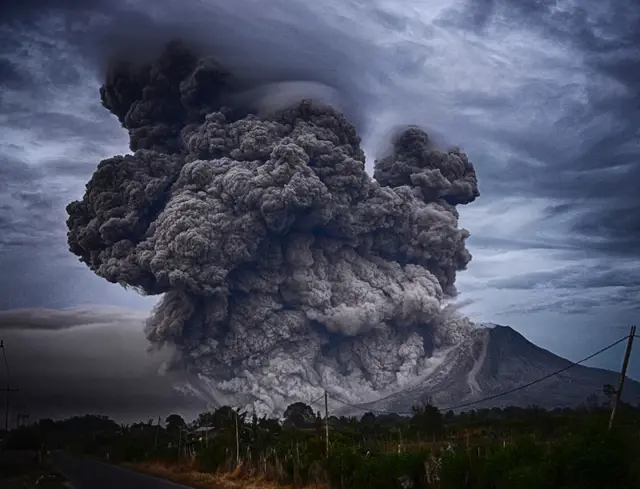
Volcanic ash from the recent eruption of Ethiopia’s **Hayli Gubbi Volcano** has reached Delhi and the surrounding National Capital Region (NCR), prompting concerns about potential health risks. The volcano erupted on **November 24-25, 2025**, after years of dormancy, sending ash, sulphur dioxide (SO2), and tiny particles high into the atmosphere. Strong winds carried this ash cloud across the Red Sea, over the Arabian Sea, and towards northwest India.
While the ash cloud is primarily suspended in the upper atmosphere, understanding its potential effects is crucial. Volcanic ash differs significantly from household ash; it comprises sharp particles made of rock, minerals, and volcanic glass. These particles can be abrasive, acidic, and irritating to the respiratory system. In some instances, the ash contains crystalline silica, which can lead to lung disease known as silicosis with long-term exposure.
According to the **Centers for Disease Control and Prevention (CDC)**, short-term exposure to volcanic ash can cause a range of symptoms, including:
– Coughing or difficulty breathing
– Sore throat
– Itchy or red eyes
– Headaches or fatigue
– Mild nausea, particularly if a significant amount of ash is inhaled
Individuals with pre-existing respiratory conditions, such as asthma or chronic bronchitis, may experience more severe symptoms. The situation in Delhi currently does not involve the heavy, long-term exposure typically associated with active volcanoes.
Dr. **Vijay Kumar Agrawal**, Director of Pulmonology and Critical Care at **Yatharth Super Speciality Hospital** in Faridabad, highlighted that respiratory risks from volcanic ash stem mainly from particulate matter (PM10 and PM2.5). The silica content, combined with SO2 — often referred to as volcanic smog or “vog” — can exacerbate respiratory issues. Inhalation of these particles may irritate both the upper and lower airways, leading to temporary symptoms such as coughing and throat irritation.
For those with existing lung diseases, exposure to volcanic ash could trigger exacerbations that may require additional medication or emergency care. Long-term occupational exposure to volcanic ash in regions close to active volcanoes has been linked to severe lung diseases, including silicosis, non-specific pneumoconiosis, and COPD-like obstructions. However, such severe outcomes typically necessitate prolonged exposure, which is not anticipated from this high-altitude ash plume.
To minimize health risks associated with the ash cloud, experts recommend:
– Staying indoors when possible and keeping windows and doors closed.
– Wearing a NIOSH-approved N95 mask if outdoor activity is necessary.
– Avoiding air conditioning units that pull in outside air.
– Gently washing ash off the skin and eyes with clean water.
– Cleaning ash from entryways and ventilation areas.
Although not everyone exposed to volcanic ash will experience serious health issues, irritation is common, particularly among sensitive individuals. With the ash plume from Ethiopia drifting towards parts of India, it is vital to stay informed and adhere to guidance from the CDC and medical professionals. Taking these precautions can help ensure safety during this unusual environmental event.

Craig Greenfield Inspires Change for Vulnerable Youth Globally

England’s Stokes and Team Criticized for Scooter Safety Violations

Black Caps Begin Home Test Summer Against West Indies in Christchurch

Sam Whitelock Advocates for Farmer Wellbeing to Combat Burnout

SkyCity Prepares for February 2026 Opening of Convention Centre

Reti Skin Launches Gift Set for Healthier, Glowing Skin

Parents Outraged as Students Served Mouldy Meals at Christchurch School

Alicia Hoskin Aims to Transform Sports Integrity for LA 2028

New Survey Reveals Home Ownership Aspirations in New Zealand

Test Your Knowledge: Take the Herald’s Afternoon Quiz Today

PM Faces Backlash from Fans During Netball Trophy Ceremony

Dunedin Designers Win Top Award at Hokonui Fashion Event

Liam Lawson Launches New Era for Racing Bulls with Strong Start

Experience the Excitement of ‘Chief of War’ in Oʻahu

Coalition Forms to Preserve Māori Wards in Hawke’s Bay

Disney Fan Reveals Dress Code Tips for Park Visitors

Walking Faster Offers Major Health Benefits for Older Adults

Scots Rally with Humor and Music to Protest Trump’s Visit
-
 World4 months ago
Test Your Knowledge: Take the Herald’s Afternoon Quiz Today
-
 Sports4 months ago
PM Faces Backlash from Fans During Netball Trophy Ceremony
-
 Lifestyle4 months ago
Dunedin Designers Win Top Award at Hokonui Fashion Event
-
 Sports4 months ago
Liam Lawson Launches New Era for Racing Bulls with Strong Start
-
 Entertainment4 months ago
Experience the Excitement of ‘Chief of War’ in Oʻahu
-
 World4 months ago
Coalition Forms to Preserve Māori Wards in Hawke’s Bay
-
 Lifestyle4 months ago
Disney Fan Reveals Dress Code Tips for Park Visitors
-
 Health4 months ago
Walking Faster Offers Major Health Benefits for Older Adults
-
 Politics4 months ago
Scots Rally with Humor and Music to Protest Trump’s Visit
-

 Top Stories4 months ago
UK and India Finalize Trade Deal to Boost Economic Ties
-

 Health2 months ago
Radio Host Jay-Jay Feeney’s Partner Secures Visa to Stay in NZ
-

 World4 months ago
Huntly Begins Water Pipe Flushing to Resolve Brown Water Issue